
The United Arab Emirates’ expanding relationship with Israel is becoming increasingly visible, particularly across multiple conflict zones in Africa. At present, the UAE is involved in disputes at more than eight locations across the African continent, and in each case, it shares a common partner: Israel. In Somaliland, the Berbera military base operates through strong Emirati-Israeli cooperation. Similarly, in Socotra, Yemen, a network of Emirati military and intelligence bases exists where Israeli personnel are not only present but are actively involved in drone operations, radar management, and integrating these systems with Israeli military equipment. These operations are primarily aimed at monitoring Houthi movements in Yemen and overseeing activity in the Gulf of Oman.
Although ties between Israel and the UAE are not new, the current conflict involving Iran has marked a historic shift. For the first time, Israel’s Iron Dome air defense system has reportedly been used outside of Israel or the United States, specifically within the UAE.
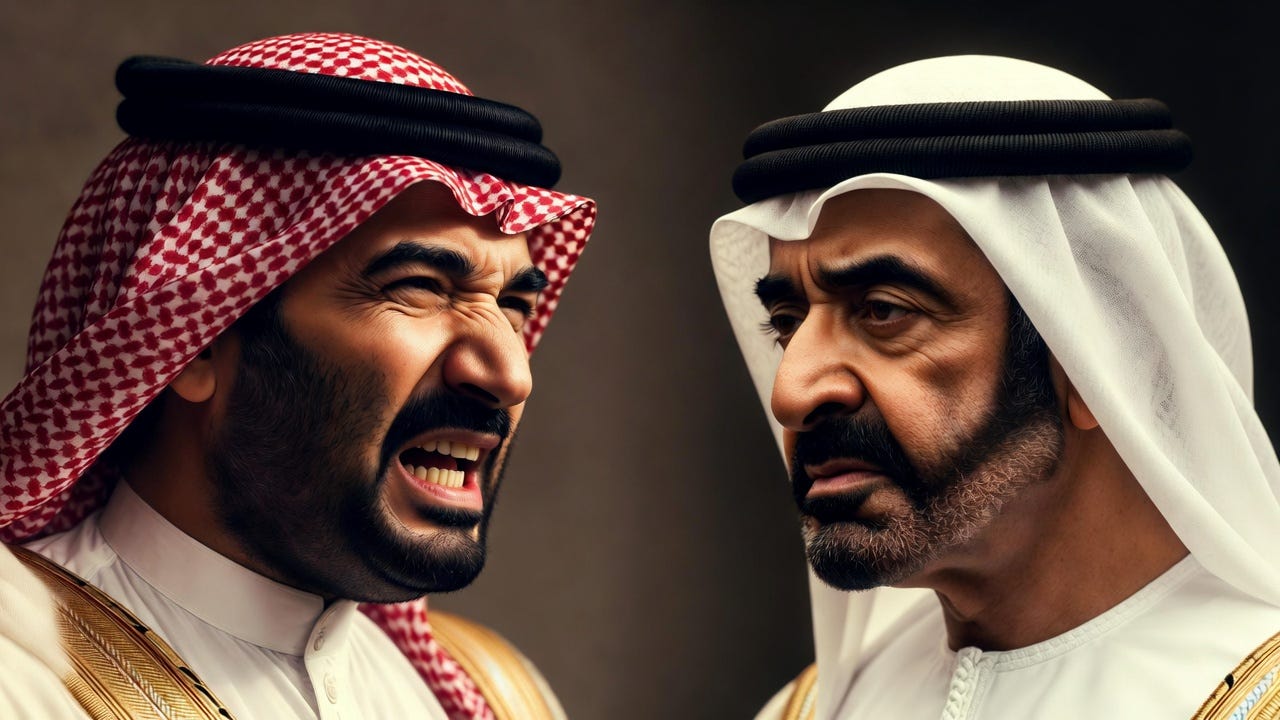
Examining Saudi-UAE relations reveals that tensions began to escalate as early as 1974 following the Jeddah Agreement. The UAE accused Saudi Arabia of annexing land, including a key route connecting the UAE and Qatar, along with oil-rich areas, in exchange for recognizing the UAE. In the early 21st century, Saudi Arabia also blocked Emirati maritime projects, alleging violations of its territorial waters.
Tensions intensified further in 2018 and 2019, when UAE-backed forces attempted operations against the internationally recognized Yemeni government, which itself was supported by Saudi Arabia. Heavy fighting erupted in Aden, resulting in dozens of casualties. More recently, in December 2025 and January 2026, the UAE-backed Southern Transitional Council (STC) seized control of Al-Mahrah and Hadhramaut regions located along the Saudi-Yemen border. In response, Saudi Arabia launched airstrikes against these UAE-supported groups and issued a 24-hour ultimatum to vacate the territories. This significantly weakened the STC and led to its partial collapse.
Currently, Saudi Arabia is confronting the UAE on two fronts: Sudan and Somaliland. In Sudan, Mohammed bin Salman recently met with Sudanese Army Chief General Burhan and assured $1.5 billion in military support through Pakistan, alongside broader economic and logistical assistance. The Sudanese Armed Forces (SAF) are engaged in conflict with the UAE-backed Rapid Support Forces (RSF). Saudi Arabia advocates for a unified central government in Sudan, while the UAE appears to favor prolonged instability, enabling it to maintain influence over RSF and control key maritime routes. Financial agreements between the UAE and RSF further underscore this dynamic.
The rivalry that began in Yemen has now expanded into Sudan and Somalia, particularly after the UAE’s exit from OPEC. DP World, an internationally recognized corporation that has also been named in the Epstein Files, has invested $440 million in Berbera, Somaliland. Meanwhile, Saudi Arabia has signed new agreements with Somalia’s central government this year to strengthen its control over Berbera and the Gulf of Oman.
Given current developments, it appears that wherever the UAE seeks to expand its influence, Saudi Arabia is actively working to counter it. This rivalry extends beyond Saudi Arabia. The UAE’s relationship with Qatar has also remained strained. Although diplomatic ties were formally restored following the Al-Ula Agreement in 2021, with embassies reopening and flights resuming, relations have not fully normalized since the 2017 crisis.
At the same time, the UAE’s relations with Pakistan have also deteriorated. In the context of the Iran conflict, the UAE’s sudden demand for repayment of $3.5 billion in loans from Pakistan is viewed as part of this broader geopolitical shift. In contrast, Pakistan’s relationship with Saudi Arabia is currently stronger than at any point in its history. Notably, when the UAE demanded repayment, Saudi Arabia promptly extended financial support to Pakistan in an equivalent amount.
The UAE increasingly appears to be isolating itself in the region, much like India. On one side, its relations with Saudi Arabia have reached a historic low; on the other, ties with Qatar remain fundamentally fragile. With a population of around nine million, the UAE seems to believe that aligning closely with Israel will help it regain its global standing, an assumption that current conditions do not support.
Overall, the situation points in one direction: growing instability for the UAE. Following the Iran conflict, the UAE’s perceived security bubble appears to have burst. Its exit from OPEC and its broader strategic posture suggest a trajectory that may lead to further destabilizing decisions in the future.